


- HERSHE Beauty FAQ
- Beauty Q&A
- Find answers to your beauty questions with HERSHE
HERSHE Beauty FAQ
|
Double Chin Muscle Tightening: When Might This Surgery Be Considered? 2026-10-07 hit.1,122 |
|
Double Chin Muscle Tightening: When Might This Surgery Be Considered?  “I thought my double chin would disappear if I lost weight, but it is still there.” “Even after liposuction, the area under my chin still looks heavy.” “My jawline bothers me more from the side than from the front.” Many people are concerned about a double chin, yet are unsure which option to choose because they do not know its exact cause. A double chin is often associated first with “fat under the chin,” but its actual contour is not determined by fat alone. Subcutaneous fat under the chin, deeper fat, the platysma that broadly covers the area beneath the chin, skin and soft-tissue elasticity, chin structure, and facial bone structure can all have an effect. So, when might double chin muscle tightening be considered? Today, we will look closely at the causes of a double chin, how this differs from liposuction, and when muscle tightening may be considered.  Is a double chin really caused by fat? Most people concerned about a double chin have a similar first thought. “I think it is because I gained weight.” Weight gain can, of course, make a double chin more noticeable as fat accumulates beneath the chin. However, the situation may be different if the area remains unchanged after weight loss or looks disproportionately thick compared with the rest of the body. A double chin should be assessed by considering the following factors together. 1. Subcutaneous fat beneath the chin : This is the most commonly assumed cause. When substantial subcutaneous fat accumulates beneath the chin, it can obscure the jawline and blur the boundary between the face and neck. In such cases, options such as liposuction may be considered after evaluating the amount and distribution of fat. 2. Fat in the deeper layers beneath the chin : Sometimes the issue is not limited to the subcutaneous fat that can be felt from the outside. At HERSHE Plastic Surgery, firm clusters of fat attached around the muscles beneath the chin are described as “grape-cluster fat.” Because this fat may be difficult to address with conventional liposuction alone, direct removal through a small incision beneath the chin may also be considered. 3. Laxity of the muscles beneath the chin : Another important structure is the platysma. The platysma extends broadly from beneath the chin into the neck. If it loosens or separates, the supporting structure may become disrupted and the jawline may look wider or less defined. In this situation, reducing fat alone may not sufficiently address the shape beneath the chin. 4. Reduced elasticity of the skin and soft tissue : A double chin may also appear more prominent when reduced skin elasticity allows the tissues beneath the chin to sag. This can include age-related changes as well as reduced elasticity after rapid weight changes. 5. Chin and facial bone structure : Some people have a noticeable double chin even without much fat. If the chin is naturally short or recessed, the boundary between the chin and neck may look relatively indistinct even when there is little fat beneath the chin. Therefore, an assessment should not focus only on “How much fat is there?” It is also important to ask, “Which structures are making the area beneath the chin look thick or sagging?” and evaluate them together. 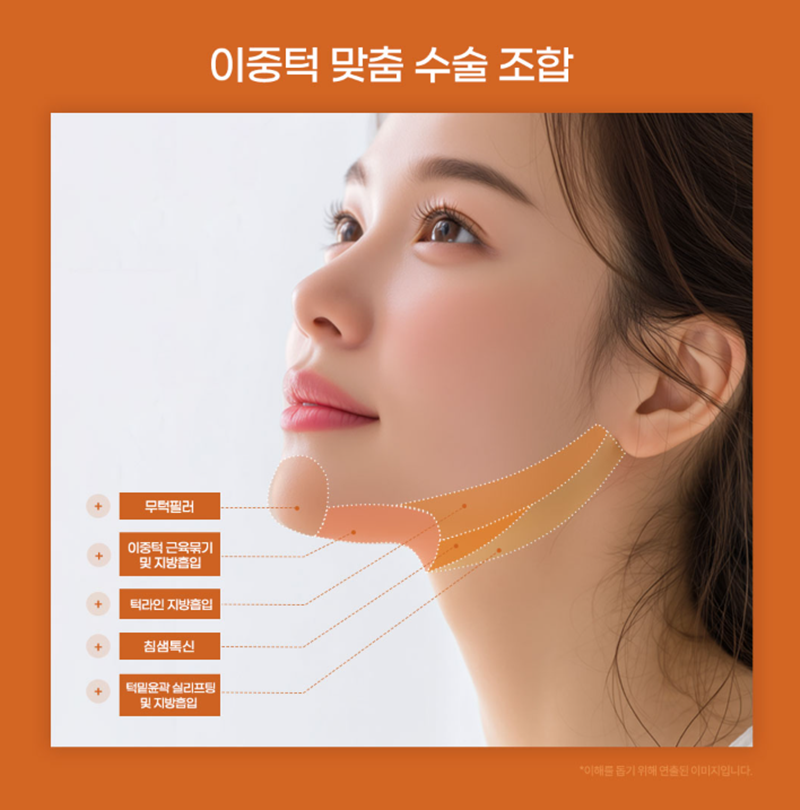 What kind of surgery is double chin muscle tightening? As its name suggests, double chin muscle tightening organizes and secures muscle structures beneath the chin that have loosened or separated. Simply put, it focuses on refining structures that spread beneath the chin to create clearer jaw–neck definition. Double chin muscle tightening does not end with “tightening only the muscle.” Fat, deeper-layer fat, and muscle should each be evaluated separately. When might double chin muscle tightening be considered? This is the key question. Muscle tightening is not necessary for every double chin. If you have the following concerns, the muscles and soft tissue beneath the chin may also need to be assessed. 1. A double chin that does not improve much with dieting : If a double chin remains even after weight loss has reduced some facial and submental fat, factors other than fat alone may also be involved. When the area beneath the chin looks disproportionately thick or sagging, the muscles and deeper tissues may need evaluation. 2. Sagging beneath the chin despite a small amount of fat : “I do not think I have much fat, but my jawline looks undefined.” In this case, clinicians can assess whether muscle laxity or sagging skin and soft tissue also contribute. Double chin muscle tightening is one option that may be considered after these structural factors are assessed. 3. An indistinct boundary between the chin and neck in profile : The area may not be very noticeable from the front but can look particularly thick beneath the chin in profile photographs. This requires assessing not only overall facial size but also how clearly the jaw–neck boundary is formed. It is advisable to assess the fat, muscles, and skin beneath the chin together. 4. Fat accompanied by sagging beneath the chin : When fat is present together with lax skin or muscle, a decision is needed on whether to reduce fat alone or also consider muscle correction or lifting. This approach does not apply equally to everyone and should be decided after assessing individual skin elasticity and fat distribution. 5. Persistent concerns after liposuction or fat-dissolving injections : Sometimes the jawline remains less defined than desired even after treatments intended to reduce submental fat. Rather than simply assuming that “more fat must be removed,” it is important to reassess whether the remaining concern is truly due to fat or to muscle or skin laxity. It is important to reassess these factors.  How do double chin muscle tightening and liposuction differ? The two surgeries are often considered the same, but they address different targets. 1. Double chin liposuction: focuses on reducing accumulated subcutaneous fat beneath the chin 2. Double chin muscle tightening: focuses on correcting a lax platysma and supporting structures beneath the chin Rather than saying one method is always better, the appropriate method should be chosen according to the cause of the double chin. For example, if subcutaneous fat is the main cause, liposuction may be considered first. Conversely, if there is little fat but the area looks broad or sagging and muscle laxity is also present, muscle correction may be considered. Because fat and muscle issues can occur together, both procedures may sometimes be performed depending on the individual condition. Before surgery, check these points first If you are concerned about a double chin, it is important to assess the area first rather than automatically choosing liposuction or muscle tightening. Check whether any of the following apply to you. 1. My double chin remains even after losing weight 2. Only the area beneath my chin looks thick compared with my body 3. My double chin bothers me more in profile than from the front 4. The boundary between my chin and neck looks indistinct 5. I notice both fat and sagging beneath my chin 6. I have had fat-reduction treatment but was not satisfied 7. The skin beneath my chin has lost elasticity and looks lax 8. A short or recessed chin makes my double chin look more prominent Having these features does not necessarily mean that double chin muscle tightening is required. The more important first step is to identify “what is causing my double chin.”  Concerned about a double chin? A double chin that remains after dieting, fullness beneath the chin after liposuction, a jawline that is more noticeable in profile than from the front, or an indistinct jaw–neck boundary should not be attributed to a single cause based only on outward appearance. It is important to assess fat and muscle, skin and soft tissue, and facial bone structure together. In particular, if the area beneath the chin looks sagging or the jawline looks broad despite a small amount of fat, the condition of the submental muscles may also be evaluated. Whether muscle tightening is needed, liposuction is suitable, or another lifting method should also be considered can vary according to the individual facial structure and tissue condition. Before deciding on surgery, it is therefore advisable to identify the cause beneath the chin accurately and choose an appropriate method after consultation. |
|
 NEXT NEXT |
 No Data. No Data. |
 PREV PREV |
What Are the Effects of MCT Metacell, and Which Skin Types May Be Suitable? |
|
|
|


- 허쉬성형외과 전문의 의료진이 콕콕 짚어드립니다.
-

 힙업리프팅으로 애플힙 뒤태 만들수있나요? 힙업성형 Q&A
-
 어깨필러 상담부터 시술과정까지, 직각어깨 REAL 현장
 쌍수하고 술 언제부터 마셔도 되나요?

- Before After
- 만족스러운 HERSHE Beauty FAQ 다음은 당신입니다.


-
1
허쉬는 대리수술이 없습니다.
진료를 담당한 의사가 직접 수술하는 것은 당연합니다. -
2
무리한 수술을 권유하지 않습니다.
디테일한 상담, 명확한 진단으로 가능한 범위 내에서
진료를 하겠습니다. -
3
끊임없는 연구와 노력을 이어갑니다.
기본부터 지키며, 성형을 발전시키는데
이바지하겠습니다. -
4
환자와 공감하고 소통하는 병원
작은 목소리도 가족이나 친구처럼 소홀히 하지 않습니다.
우리가 약속할수 있는 것
PREFER TO CONTACT US DIRECTLY?
Direct 1:1 consultation
Choose one of the channels below to begin a direct conversation with our English consultation team.


Online Consultation
Online Consultation
-
Weekdays 10:00 a.m. to 7:00 p.mSaturday 10:00 a.m. to 4:00 p.m
-
730, 2~4th floor, 63-12, Cheongdam-dong, Gangnam-gu, Seoul
Business registration number: 211-09-46633 | Mail order sales report number: 2011-Seoul Gangnam-02924 - Advertising / Affiliate Inquiry Contact Telephone: 02-518-6688 / E-mail: hershe.eng@gmail.com


